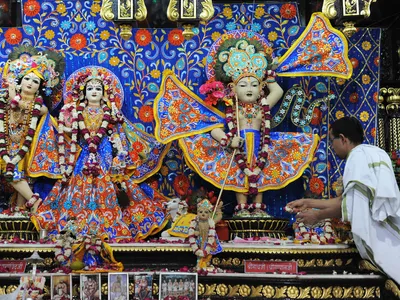

Significance of the day
Akshaya Tritiya as one of the most important days in the Vedic Calendar. On this day, Surya (the sun) and Chandra (the moon) are both in a state of exaltation — their greatest brilliance — simultaneously, which happens only once a year. According to Vedic texts, this was also said to be the day the ancient Rishis performed the first Yagya in history, marking the beginning of an era when people lived in harmony with Natural Law. The word Akshaya itself means “undecaying” or “everlasting.”
Maharishi Yagyas on this day
Maharishi’s Global Country of World Peace celebrate Akshaya Tritiya as the “Day of Lasting Achievements,” with Maharishi Yagya performances specifically timed to take advantage of the day’s auspicious quality. These yagyas help with goals like increasing wealth, removing obstacles, gaining knowledge, promoting harmony and spiritual progress, and more.
Practical actions on Akshaya Tritiya
One recollection mentions that that once, on the eve of Akshaya Tritiya, Maharishi summoned his Vedic pundits and asked them to immediately perform Bhoomi Puja (ground-breaking ceremonies) to establish new Vedic centres across India — even though the organisation had no land in any of those locations. Maharishi insisted it be done at once, refusing to take “no” for an answer. It was characteristic of his style to act boldly on auspicious timings.
In essence, Maharishi gave Akshaya Tritiya a prominent place in the Vedic calendar — it was a day for beginning lasting works, performing yagyas, and aligning human action with what he saw as the most supportive cycles of natural law.
A few sacred stories about Akshaya Tritiya from various sources:
Krishna and the Akshaya Patra
During the Pandava’s exile in the forest, Draupadi was pained that she could not offer food to the sages who visited them. Yudhishthira prayed to Lord Surya, who gifted him the Akshaya Patra—a divine vessel that would never run out of food until Draupadi had eaten her own meal. When the fierce sage Durvasa arrived with his disciples after Draupadi had already eaten, Krishna himself came and ate the single grain of rice stuck to the vessel. With that one act, the entire universe felt satiated, and Durvasa and his disciples left fully satisfied. This happened on Akshaya Tritiya.
Krishna and Sudama (Kuchela)
Krishna’s childhood friend Sudama lived in dire poverty. Gathering his courage, he visited Krishna in Dwarka carrying nothing but a humble cloth bundle of beaten rice. Though Sudama was too shy to offer it, Krishna lovingly took the flattened rice and ate it with great relish. When Sudama returned home, his small hut had transformed into a palace. The little he gave with pure love was returned to him a thousandfold. This too is believed to have happened on Akshaya Tritiya.
Draupadi’s Vastraharan
When Dushasana attempted to disrobe Draupadi in the court of the Kauravas, she surrendered completely to Krishna. The cloth that covered her became Akshaya —never-ending, ever-flowing —protecting her honor. Once again, the theme of the “imperishable” appears on this sacred day.
The Birth of Parashurama
The sixth avatar of Lord Vishnu, the warrior-sage Parashurama, is believed to have been born on Akshaya Tritiya. He came to restore dharma and destroy corruption–a reminder that this day carries the energy not just of abundance, but of righteous transformation.
The Writing of the Mahabharata
Sage Vyasa began dictating the great epic Mahabharata to Lord Ganesha on this day—the longest poem ever written, a work that is itself Akshaya, eternal and never-ending.
Goddess Annapurna
The goddess of food, Annapurna–a form of Goddess Parvati–was born on this day. Later, Lord Shiva himself came to her as a beggar in Kashi to receive alms, establishing her as the eternal nourisher.
Kubera’s Appointment
Lord Kubera received his position as the treasurer of the Devas–the god of wealth–on this day. This is why Kubera-Lakshmi Puja is especially powerful on Akshaya Tritiya.

Leave a Reply